



Introduction
“How much will it cost?” is the first question almost every client asks before planning an event in Singapore — and the most common answer they get is a frustrating “it depends.” While every event genuinely is different, that doesn’t mean you should go in blind.
This guide breaks down realistic 2026 price ranges for the most common types of events in Singapore, explains exactly what drives those costs up or down, and shows you how to budget with confidence. Whether you’re planning a product launch, a multi-day conference, or a brand activation roadshow, you’ll walk away knowing roughly what to expect and where your money goes.
What “event management” actually includes
Before talking numbers, it helps to understand what you’re paying for. A full-service event management company in Singapore typically handles some or all of the following:
- Conceptualisation and creative direction — the big idea, theme, and look-and-feel
- Venue sourcing and management — finding, booking, and liaising with the venue
- Production — staging, audio, visual, lighting (AVL), and fabrication
- Logistics and operations — vendor coordination, manpower, scheduling, permits
- On-site management — running the event on the day, troubleshooting live
- Post-event support — teardown, reporting, and publicity
Some clients want the full package; others only need production support or on-the-day coordination. Your scope is the single biggest factor in your final cost.
Typical event management cost ranges in Singapore (2026)
The figures below are indicative market ranges for professionally managed events. They are starting points for budgeting, not quotes — your actual cost depends on the factors covered further down.
Event type | Typical budget range (SGD) | What’s usually included |
Small corporate event / private function (50–100 pax) | $8,000 – $25,000 | Venue coordination, basic AVL, light styling, on-site crew |
Product launch / brand activation | $20,000 – $80,000+ | Creative concept, custom fabrication, AVL, staffing, publicity |
Conference / seminar (half to full day) | $25,000 – $120,000+ | Stage design, full AVL, registration, speaker management, livestream |
Multi-day conference / exhibition | $80,000 – $300,000+ | Multiple zones, exhibitor booths, complex logistics, daily operations |
Gala dinner / awards night | $40,000 – $150,000+ | Premium venue, entertainment, custom staging, F&B coordination |
Roadshow / mall activation (per location) | $10,000 – $40,000 | Pop-up setup, manpower, samples, mobile assets |
Rule of thumb: Many agencies charge a management fee of 10–20% of total project cost for full-service planning. On a $100,000 event, that works out to roughly $10,000–$20,000 for the planning and coordination layer, on top of the production and vendor costs.
The 7 factors that drive your event cost up or down

1. Guest count
More guests means a larger venue, more F&B, more staff, and bigger AVL coverage. Cost rarely scales linearly — doubling your headcount can more than double certain line items once you cross venue capacity thresholds.

2. Venue
Venue is often the single largest line item. A hotel ballroom, a convention centre hall, and a non-traditional space (warehouse, rooftop, museum) carry very different price tags — and non-standard venues often need more production spend to make them event-ready.
3. Production complexity (AVL and staging)
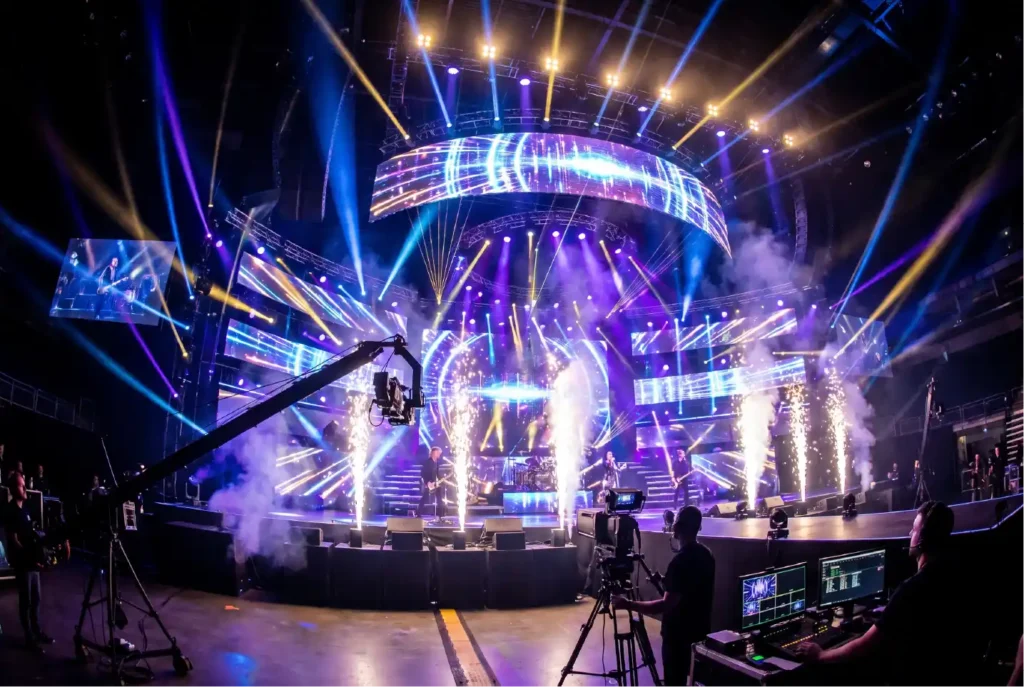
A simple speaker setup with a screen and a couple of speakers is modest. A custom-built stage with LED walls, programmed lighting, multi-camera livestreaming, and special effects is where budgets climb fastest.

4. Creative and fabrication
Bespoke builds — themed sets, custom booths, immersive installations, large-format printing — are labour- and material-intensive. Off-the-shelf modular solutions cost far less than fully custom fabrication.

5. Manpower and duration
Crew, emcees, brand ambassadors, technical operators, and security all bill by time. A longer event, an overnight setup, or a multi-day run multiplies manpower costs.

6. Timeline
Tight turnarounds cost more. Rush fabrication, last-minute vendor bookings, and overtime crew rates can add a meaningful premium. Booking 8–12 weeks ahead almost always saves money.

7. Add-ons and “nice-to-haves”
Entertainment, photography/videography, gifting, livestream production, post-event content, and PR amplification are commonly underestimated. List these early so they’re in the budget, not a surprise.
How to budget smartly for your event
- Start from the total, not the wish list. Fix your all-in number before you fall in love with any single element — then split it across venue, production, creative, and contingency. Working backwards from a total keeps one impressive idea from quietly eating the whole budget.
- Budget the contingency as a line item. Ring-fence 10–15% and treat it as spent, not spare. On almost every event something shifts late — a speaker change, a weather call, a venue requirement — and the contingency is what keeps that from becoming a crisis.
- Spend where it’s seen. Concentrate spend on the two or three moments guests actually remember — the reveal, the stage, the experience — and strip cost from the things no one notices. Even spreading isn’t the same as smart spending.
- Lead with the budget, not against it. Give your agency the real number up front. A good one designs to your budget from the start; withholding it usually means a proposal that overshoots and forces painful cuts later.
- Compare scope, not headline price. A cheaper quote that leaves out manpower, permits, or teardown isn’t cheaper — it’s incomplete. Line the quotes up item by item before you compare the totals.
Agency vs DIY: which makes sense for your event?
Running an event in-house can be the right call — for a small, familiar format like a team offsite or a modest networking evening, an organised internal team may not need an agency at all. Where the calculation changes is scale, stakes, and complexity.
In-house looks cheaper on paper, but the real comparison includes the costs that don’t show up in a quote: the staff hours pulled away from their actual jobs, the vendor mark-ups you pay without established relationships, and the exposure when something goes wrong live and there’s no experienced crew to absorb it. An agency brings negotiated vendor pricing, production efficiency, and the operational muscle to handle problems in real time. For a high-stakes launch, conference, or client-facing event, that usually outweighs the fee; for a low-risk internal gathering, it may not. The honest answer depends on how much a bad day would cost you.
Frequently asked questions
There’s no single average because events vary so widely, but most professionally managed corporate events fall between around $8,000 for small functions and $120,000+ for full conferences. Product launches and brand activations commonly land somewhere in the $20,000–$80,000 range.
Both models exist. Many full-service agencies charge a management fee of 10–20% of total project cost, while others quote fixed project fees. Always confirm which model applies and what’s included.
For larger events, 8–12 weeks minimum is ideal. Complex conferences and exhibitions benefit from 3–6 months of lead time. Earlier booking gives you better vendor rates and more venue choice.
Yes. The most accurate way to budget is to share your event type, guest count, preferred dates, and rough budget with an agency so they can build a tailored proposal.
Plan your next event with confidence
Costs are easier to manage when you understand what drives them — and when you’re working with a team that designs to your budget instead of around it. INX has delivered corporate events, conferences, and brand activations across Singapore since 2012, and we’re happy to build a transparent, itemised proposal so you can see exactly where every dollar goes.