



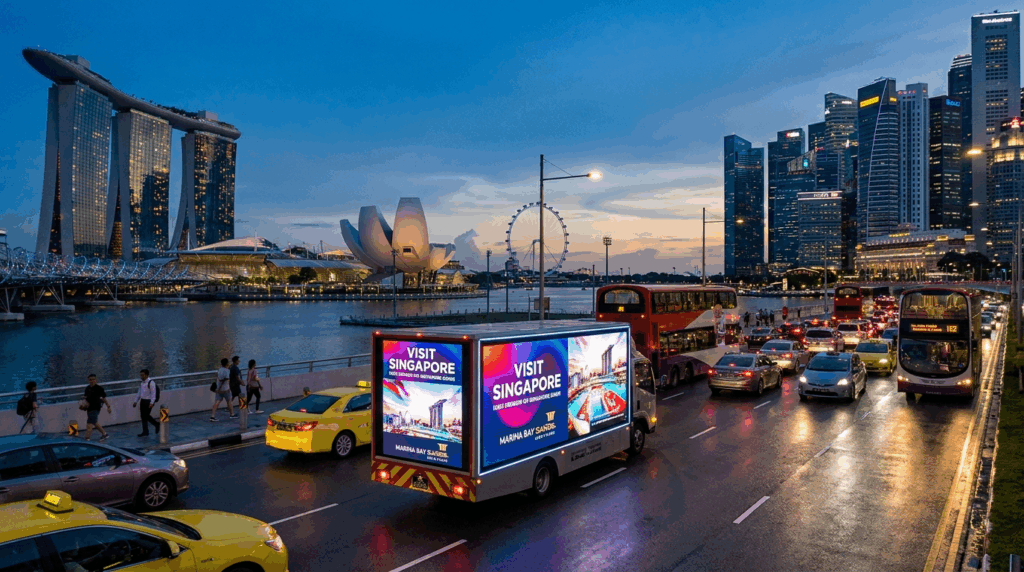
Billboards stay put. Your audience doesn’t. That simple insight is the whole case for vehicle advertising — putting your message on a truck, van, or car that travels to where your customers actually are, instead of waiting for them to walk past a fixed sign.
Mobile advertising is one of the most flexible and attention-grabbing formats in out-of-home (OOH) marketing, and it’s particularly effective in a dense, high-traffic city like Singapore. This guide explains how vehicle advertising works, what it costs, the local rules you need to know, and when it’s the right choice for your campaign.
What is vehicle advertising?
Vehicle advertising is a form of out-of-home advertising that places your brand message on moving or parked vehicles. It ranges from simple decals on a company car to large, illuminated mobile billboards built specifically for advertising. The main formats are:
- Mobile billboard trucks — purpose-built trucks carrying large static or LED display panels
- LED advertising trucks — trucks with bright digital screens that can rotate multiple ads and run video
- Vehicle wraps and decals — vinyl graphics applied to cars, vans, or buses
- Branded fleet vehicles — turning your own delivery or service vehicles into rolling ads
- Mobile activation vehicles — branded caravans or carts that combine advertising with sampling or experiences
How vehicle advertising works in Singapore
The core idea is targeted movement. Rather than hoping the right people pass a fixed location, a mobile billboard is routed through the areas and at the times your audience is most active — the CBD at lunch, shopping belts on weekends, residential heartlands in the evening, or a specific event venue on the day.
A typical campaign involves choosing your format (static panel vs LED screen), designing the creative for maximum roadside legibility, planning the route and schedule around your target audience, and running the vehicle for a set number of hours or days. LED trucks add the flexibility to rotate several messages or sync timing to specific locations.
What does vehicle advertising cost in Singapore?
Costs depend heavily on the format, the size of the display, the duration, and whether you need creative and production. The ranges below are indicative for budgeting only.
| Format | Typical cost (SGD) | Notes |
|---|---|---|
| Vehicle wrap / decal (production) | $1,500 – $6,000+ | One-time design and application; varies with vehicle size and coverage |
| Mobile billboard truck (static panel) | $1,500 – $4,000 per day | Includes driver and routing; multi-day rates lower per day |
| LED advertising truck | $2,500 – $6,000+ per day | Premium for digital display, video capability, and rotation |
| Mobile activation vehicle | $4,000 – $15,000+ per campaign | Combines advertising with on-site sampling or experience |
Tip: Per-day rates usually drop for multi-day bookings, and bundling creative production with the media buy is often more cost-effective than sourcing them separately.
The rules: what you need to know in Singapore
Advertising on vehicles in Singapore is regulated, and the requirements differ by vehicle type, by whether the display is illuminated or digital, and by where the vehicle operates. The most common friction points are the ones below — knowing them upfront saves time and avoids a campaign being pulled mid-run.
- Permits and approvals — An LED or illuminated display, and advertising on commercial vehicles, is the category most likely to need approval from the relevant authorities. Static vinyl wraps on a private vehicle sit at the lighter end; a bright digital truck panel sits at the heavier end. Budget lead time for approvals accordingly.
- Road safety and display rules — Displays are restricted on size, brightness, animation, and placement so they don’t distract drivers. Digital screens in particular may face limits on how fast creative can change and how bright it can run, especially at night. This is why LED trucks need creative built for the format, not repurposed social ads.
- Content standards — Content must comply with Singapore’s advertising codes — the same standards that apply to any local campaign cover claims, restricted categories (e.g. alcohol, healthcare), and offensive material.
- Vehicle and operator licensing — The vehicle itself, and its use for advertising, must meet the applicable vehicle and operator licensing requirements.
Because the rules vary by case and change over time, the practical route is to work with a provider who handles compliance, approvals, and routing as part of the package — so the regulatory work happens before the truck ever hits the road, not after. This guide is general information, not legal or regulatory advice; verify current requirements with the relevant Singapore authorities or your provider before launching.
When does vehicle advertising work best?
Vehicle advertising shines in specific scenarios:
- Product launches — create buzz and visibility in the run-up to and during a launch
- Event promotion — drive awareness around a concert, exhibition, or sale by routing past target areas and the venue itself
- Geographic targeting — concentrate impressions in specific neighbourhoods, business districts, or near competitors
- Sampling and activation tie-ins — pair the moving billboard with an on-the-ground experience
- Reinforcing a wider OOH campaign — add a dynamic, mobile layer to static billboards and digital OOH
It’s less suited to campaigns that need detailed messaging (roadside attention spans are short) or precise audience data and attribution — though pairing it with QR codes and digital follow-up helps close that gap.
A quick example: when mobile beats a fixed placement
Say you’re launching a new outlet in Jurong and want three days of pre-opening buzz. A fixed billboard near the mall costs the same whether or not your audience is there, and it only reaches people who happen to pass that one spot. A mobile billboard truck can spend the morning circling the nearby MRT interchanges and bus stops during commuter peaks, park near the HDB heartlands and food centres at lunch, then run the shopping belt on the evening the outlet opens — concentrating every impression on the catchment you actually care about, at the moments people are out. For a short, geographically focused push like this, the mobile route turns the same budget into far more relevant exposure than a single fixed panel could.
Vehicle advertising vs traditional billboards
| Factor | Vehicle advertising | Fixed billboard |
|---|---|---|
| Location | Mobile — goes to the audience | Fixed — audience must pass it |
| Targeting | Route and time can be planned | Limited to the billboard’s location |
| Flexibility | Change routes, timing (LED: change creative) | Static for the booking period |
| Attention | Novelty and movement draw the eye | Familiar, easily tuned out |
| Best for | Launches, events, geo-targeting | Long-term presence at a key location |
How to make your vehicle advertising campaign work
- Keep creative bold and simple. Big logo, short message, high contrast — it needs to read in a couple of seconds from a moving vehicle.
- Plan the route around your audience, not convenience. Match locations and times to where and when your customers are out.
- Add a digital hook. A QR code or short URL turns roadside attention into measurable action.
- Run long enough to build frequency. A single pass is forgettable; repeated exposure across days builds recall.
- Coordinate with your other channels. The mobile billboard works hardest when it echoes a wider campaign.
Frequently asked questions
Is vehicle advertising legal in Singapore?
Yes, but it’s regulated. Certain formats — particularly illuminated and LED displays and advertising on commercial vehicles — may require approvals and must meet road safety and content rules. Always confirm current requirements before launching.
How much does a mobile billboard truck cost per day in Singapore?
Indicatively, static-panel mobile billboard trucks run roughly $1,500 – $4,000 per day, while LED advertising trucks typically start around $2,500 per day and rise from there depending on screen size and features. Multi-day bookings usually reduce the per-day rate.
How effective is vehicle advertising compared to digital ads?
They do different jobs. Vehicle advertising delivers high-impact, real-world brand visibility and works especially well for launches and geo-targeted campaigns, while digital ads excel at precise targeting and measurement. Many brands use both together.
Can I target specific areas of Singapore?
Yes — that’s one of the biggest advantages. Routes and schedules can be planned to concentrate impressions in the districts, heartlands, or event locations that matter most to your campaign.
Put your brand on the move with INX
Vehicle advertising turns Singapore’s roads into your media space — but the results come from the right format, smart routing, compliant execution, and creative that lands in seconds. INX runs mobile advertising vehicles and out-of-home campaigns across Singapore, handling everything from concept and fabrication to routing and approvals.
Explore mobile vehicle advertising with INX →
Contact Us to start planning your campaign.
Disclaimer: Pricing is indicative for budgeting only and not a quotation. Regulatory information is general and may change — verify current rules with the relevant Singapore authorities or your advertising provider before launching a campaign.