



Introduction
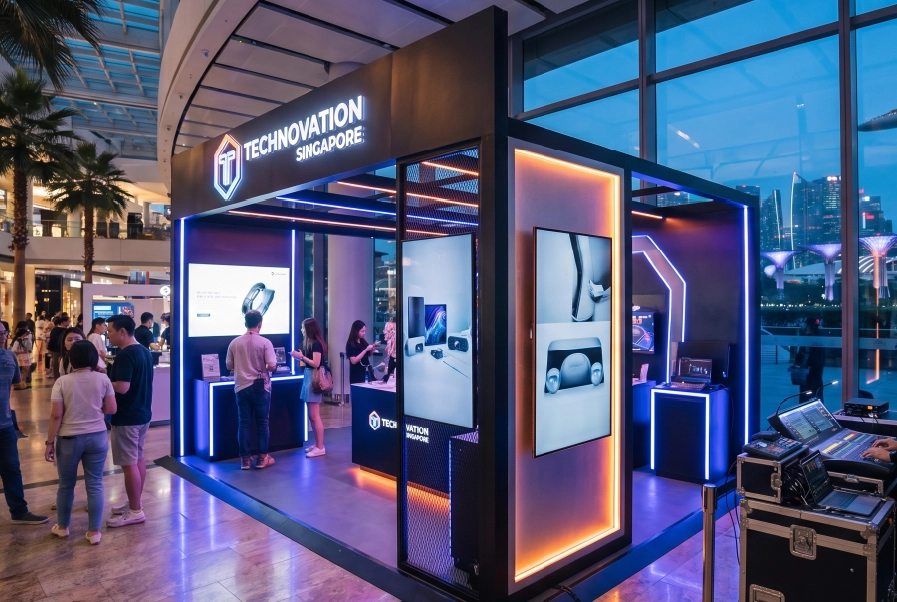
A pop-up store or exhibition booth is one of the few times your brand becomes a physical space people can walk into. In those few square metres you have seconds to stop someone and give them a reason to remember you.
Whether you’re launching a product, activating at a mall, or standing out on a crowded exhibition floor, the design and build decide the outcome. This guide covers how to plan a pop-up or booth in Singapore, what good design and fabrication actually involve, realistic budgeting, and the delivery details that determine whether your space pulls a crowd or gets walked past.
Pop-up stores vs exhibition booths: what’s the difference?
- Pop-up stores are temporary, standalone branded retail or experience spaces — often in malls, public areas, or vacant units — designed to create buzz, sell, sample, or build brand experience over days or weeks.
- Exhibition booths are your branded footprint within a larger trade show or exhibition, competing for attention against many other stands in the same hall.
The design principles overlap heavily, but the context differs: a pop-up owns its space and sets the mood; a booth must cut through a dense, competitive environment.
Why pop-ups and booths work
- Physical presence builds trust in a way digital alone can’t
- They create urgency — temporary by nature, they give people a reason to act now
- They’re experiential — people can touch, try, and engage with the product
- They generate content — striking spaces are made to be photographed and shared
- They capture data and leads in a face-to-face, high-intent setting
What actually stops traffic
Most design guides talk about being “eye-catching.” Useful, but vague. In practice, footfall stops for a specific, physical set of reasons — and you can design for each of them:
- Sightline and height. A booth that reads at eye level competes with a hundred others. Height, a raised header, or a hanging sign (where the venue allows rigging) lifts your brand above the crowd and can be seen three aisles away. This is the single biggest traffic driver on a busy floor.
- A brightness contrast. The eye goes to the brightest point in view. In a flatly-lit mall atrium or hall, focused, brighter-than-ambient lighting on your product or hero graphic makes people look before they’ve read a word. Underlit booths physically disappear.
- Something in motion. Movement, a screen, a live demo, or staff actively doing something reads as “activity” from a distance and pulls people over — an empty, static booth signals “nothing happening here.”
- A low barrier to entry. People commit to entering a space they can see into and exit easily. Open corners, a low or absent front counter, and a clear path in remove the subconscious “will I get trapped by a salesperson” hesitation.
- One legible message. One bold message beats five clever ones. If a passer-by can’t tell what you offer in the two seconds they’re in range, they keep walking. Lead with the single most compelling thing.
What great pop-up and booth design involves

1. A clear single idea
The strongest spaces communicate one thing instantly. Visitors should grasp who you are and why you matter within seconds of approaching.

2. An inviting layout
Open, easy-to-enter designs draw people in; cramped or “closed” layouts push them away. Plan the flow so visitors naturally move through the space, and keep the most engaging element visible from the aisle.

3. A focal interaction
Give people something to do — try the product, play, take a photo, get something personalised. Interaction turns a glance into a genuine engagement, and gives staff a natural way to start a conversation.

4. Brand consistency
Every element — colours, materials, typography, lighting, messaging — should reinforce the brand so the space feels unmistakably yours, and consistent with the campaign it belongs to.

5. The shareable moment
Design at least one deliberately photogenic feature — a bold backdrop, an installation, a mirror or neon moment — that visitors want to capture and post, extending your reach beyond the physical space. Make it obvious where to stand and easy to frame.
The fabrication process, step by step
- Brief and concept — objectives, brand guidelines, space, and budget defined
- Design and visualisation — 2D layouts and 3D renders so you can see it before it’s built
- Material and method selection — balancing impact, durability, budget, and reusability
- Fabrication and build — skilled construction, printing, and finishing, ideally in-house for quality control
- Pre-build / dry run — assembling and checking before the live install where feasible
- Installation on-site — delivery, assembly, and setup within venue load-in windows
- Teardown and storage — dismantling and, for reusable builds, storing for future use
Working with a fabricator that has an in-house team typically means better quality control, tighter timelines, and more accountability than coordinating multiple subcontractors.
What does a pop-up or exhibition booth cost in Singapore?
Costs vary widely with size, complexity, materials, and whether the build is custom or modular. The ranges below are indicative for budgeting only.
Type | Indicative cost (SGD) | Notes |
Small modular booth | $3,000 – $10,000 | System-based, quicker, reusable elements |
Custom exhibition stand | $10,000 – $50,000+ | Bespoke design and fabrication, higher impact |
Mall / public pop-up store | $10,000 – $60,000+ | Includes build, branding, fixtures, install |
Large flagship pop-up / immersive | $50,000 – $150,000+ | Complex fabrication, tech, and experience design |
Tip: Modular and reusable builds cost more upfront but save money across repeated activations. If you exhibit regularly, a reusable system can pay for itself.
Delivery realities at Singapore venues
The best-designed booth still fails if it can’t be built the way the venue allows. A few specifics worth confirming before you finalise a design:
- Height and rigging limits. Halls like Suntec, Marina Bay Sands Expo, and Sands Expo & Convention Centre publish stand-height limits, rigging and hanging-sign rules, and whether raised platforms or double-decker builds are permitted. Design to the limit you’re given, not the one you’d like.
- Mall activation rules. Malls (e.g. atriums at VivoCity, ION, Jewel) are strict on build height, footprint, fire access, and what can be fixed to floors and walls. Atrium activations are often tightly bounded and need landlord approval on look and structure.
- Load-in windows. Load-in and teardown windows are short and shared with other exhibitors. Freight lift sizes, dock access, and after-hours labour rules all shape how — and how fast — you can install. Get these in writing before committing to a complex build.
- Power and lighting. Never assume the stand’s power allocation covers your lighting, screens, and demo units — order the right supply in advance. Plan lighting from the start, because it’s the difference between a booth that reads across the hall and one that vanishes.
Practical things planners forget
- Storage and reuse. If you’ll use it again, design for easy dismantling and storage — it changes material and joinery choices.
- Staffing. A beautiful space still needs trained, engaging people to convert footfall — brief and rehearse them, don’t just staff the shift.
- Lead capture. Have a clear, low-friction way to collect contacts and follow up — a QR code beats a paper form.
- Timeline. Custom fabrication takes time — rushing risks quality and cost overruns. Book design and build weeks out, not days.
Frequently asked questions
Indicatively, mall and public pop-ups commonly range from around $10,000 to $60,000+ depending on size, fabrication complexity, fixtures, and install — with large flagship or immersive builds costing more.
It depends on complexity. Modular booths can be turned around relatively quickly, while fully custom stands need more lead time for design, fabrication, and finishing — typically several weeks. Book early to protect quality.
Custom booths are designed and built bespoke for maximum impact and brand fit; modular booths use reusable system components that are faster and more cost-effective, especially across repeated events.
Yes — if designed for it. Reusable and modular builds are made to be dismantled, stored, and reassembled, lowering the cost per activation over time.
Build a pop-up or booth that stops the crowd with INX
A standout pop-up or exhibition booth is equal parts creative design and fabrication craft — and the brands that win the floor invest in both. INX keeps that craft in-house: our own workshop and team of makers handle large-format printing, fabrication, finishing, and build under one roof. That means tighter quality control, timelines we can actually hold, and one accountable team from render to install — rather than a design passed between subcontractors and hoped for on load-in day.