



Introduction
An immersive brand experience looks, on the day, like magic: people walk in, light up, film everything, and leave talking about it. What that moment hides is the engineering underneath — the sightlines worked out on a floor plan, the throughput maths, the sound zones, the reset between groups, the crew running it all to a cue sheet. The idea is what gets pitched; the delivery is what decides whether it works.
This guide is about both, but weighted toward the part most articles skip. It covers what experiential and immersive marketing are, the formats that deliver, and — in the most detail — the spatial, production, and audience-flow realities that separate an experience that runs smoothly from one that jams up, underwhelms, or falls apart at peak.
What is experiential marketing?
Experiential marketing engages audiences through direct, participatory experiences rather than one-way messaging. The audience doesn’t just see the brand — they interact with it, physically and actively.
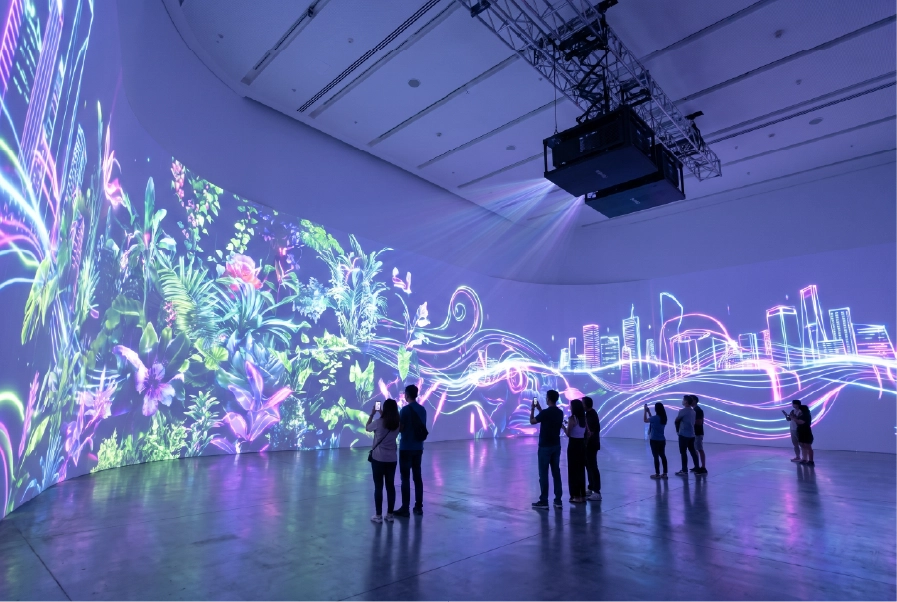
Immersive experiences are a high-impact subset: environments designed to surround and absorb the audience so they feel inside the brand’s world rather than in front of an ad. Projection-mapped rooms, multi-sensory installations, and responsive themed spaces are typical forms. The shared aim is a genuine interaction that people remember and, increasingly, one that generates content they share on their own.
Why immersive experiences work
- Participation beats observation. Active participation is more memorable and creates more involvement than a passive ad — people recall what they did, not just what they saw.
- Attention is earned, not interrupted. A genuinely interesting experience pulls people in rather than pushing at them, so you earn attention instead of buying it.
- They’re built to be shared. Striking, photogenic moments turn attendees into broadcasters, so the on-site crowd seeds a much larger online reach.
- They cut through ad fatigue. In a world of skippable, blockable, scrollable advertising, a real-world experience is one of the few formats that can’t be closed in a tab.
Immersive and experiential formats that deliver

Projection mapping and digital environments
Turning walls, objects, or whole rooms into dynamic canvases creates transformation flat screens can’t match — ideal for reveals and storytelling. Production reality: it needs controllable low ambient light (hard in bright malls), correctly placed and calibrated projectors, and content built precisely to the mapped surfaces — so the space and the content have to be designed together, not sequentially.

Multi-sensory installations
Engaging sight, sound, touch, and scent deepens immersion. Production reality: scent lingers and drifts between zones, sound bleeds into neighbouring spaces, and touch surfaces need cleaning and durability planning for high throughput. Each added sense adds an operational variable to control.

Interactive and responsive tech
Motion sensors, touchpoints, AR, and gamified interactions let visitors shape the experience. Production reality: interactive tech is the most likely thing to fail live and the hardest to fix mid-show, so it needs redundancy, a manual fallback, and a technician on hand — not just a working demo the week before.

Themed environments and sets
Fully built worlds transport visitors and generate endless content. Production reality: this is fabrication-heavy — the build quality, finish, and durability under crowd contact are what separate a convincing world from an obvious set, and it all has to survive load-in, the run, and teardown.

Pop-ups and experiential retail
Temporary spaces blending product, story, and experience, creating urgency and a destination. Production reality: these live or die on location approvals, footprint, and the same crowd-flow constraints as any retail activation.

Live performance and spectacle
Performers and theatrical moments add energy and a “you had to be there” quality. Production reality: performance runs to a schedule, which means show times, sightlines for a standing crowd, audio coverage, and a stage/clear zone that the rest of the flow has to accommodate.
What makes immersive experiences hard to deliver live
This is where most experiences are won or lost, and where a designed-on-paper concept meets a room full of real people. The considerations below should shape the concept from the start — retrofitting them later is expensive and usually compromises the idea.
- Physical space first. The experience has to be designed to the actual space — ceiling height, column positions, power locations, entrances, and exits. A concept drawn without a real floor plan almost always has to be cut down once it meets the venue.
- Audience flow and a designed path. People need an obvious way in, a clear path through, and an exit that doesn’t collide with the entrance. Bad flow creates bottlenecks that cap how many people you can process and sour the experience for everyone stuck in them.
- Throughput and dwell time. Every immersive experience has a throughput ceiling — visitors per hour — set by how long one person or group takes inside. Multiply expected footfall against that and you’ll know whether you have a smooth flow or a two-hour queue at peak. This maths should happen before the build, not on opening day.
- Reset time between groups. If groups move through in waves, the space needs to reset between them — clearing, re-cueing, sometimes resetting props or tech. Reset time eats into throughput and has to be built into the cycle, or the experience backs up.
- Lighting and sound control. Immersive experiences depend on controlling light and sound, which is hard in shared or open venues. Ambient light kills projection; sound from the next activation bleeds into your carefully designed audio. Both often require built enclosures, blackout, or acoustic treatment that the concept has to account for.
- Safety and compliance. Built environments, crowds, and tech carry real safety obligations — structural stability, clear egress, fire and electrical compliance, and crowd management. These aren’t optional add-ons; in many venues they gate whether you’re allowed to open at all.
- Content designed to the space. Content has to be designed for the surface and the dwell time — a two-minute projection loop for a thirty-second walk-through wastes most of it. Content, space, and pacing are one design problem, not three.
- Staffing and operation. Immersive experiences need trained staff to guide groups, manage pacing, run the tech, and keep energy up across a long day. Under-staffing or under-briefing is one of the most common reasons a strong build underdelivers live.
How to design an immersive experience that works
- Start with the outcome, not the tech. Decide what you want people to do and leave with, then choose formats that deliver it. Technology serves the idea, not the reverse.
- Build a clear narrative through the space. The best immersive experiences have a beginning, a peak moment, and a payoff — mapped onto the physical path people walk.
- Engineer the shareable moment. Design at least one deliberately photogenic, content-worthy beat, and make it obvious where to stand and easy to frame.
- Pressure-test the delivery early. Run the throughput, flow, reset, light, sound, and staffing numbers against the concept before you build, and adjust the idea to fit reality.
- Connect it to the brand goal. Wonder is worthless if it doesn’t tie back to your product, message, or a desired action.
- Plan the data and follow-up. Capture interest in the moment and have a concrete path to continue the relationship afterward.
Measuring the impact of experiential marketing
Experiential campaigns can absolutely be measured — you just need to define success upfront. Useful metrics include:
- Footfall and dwell time — how many engaged, and for how long
- Engagement depth — interactions per visitor, completion of the experience
- Content and amplification — user-generated posts, shares, hashtag use, earned media
- Data captured — leads, sign-ups, opt-ins
- Conversion — sales, redemptions, or qualified leads tied to the experience
- Brand lift — shifts in awareness, sentiment, and perception via surveys
Pick one or two primary metrics before you build, so the experience is designed to deliver them.
Common pitfalls to avoid
- Tech for tech’s sake. Impressive gadgets with no story or purpose feel hollow.
- No clear brand connection. A fun experience that doesn’t reinforce the brand is a missed opportunity.
- Forgetting amplification. The on-site crowd is small; design for the much larger online audience.
- Underestimating logistics. Immersive builds are production-heavy — power, safety, crowd flow, and crew all need planning.
- No follow-up. Capturing attention and then going silent wastes the momentum you created.
Frequently asked questions
Experiential marketing is the broad approach of engaging audiences through participation; immersive marketing is a high-intensity form that surrounds the audience in a designed environment. Immersive experiences are one powerful tool within experiential marketing.
No. While large brands run headline-grabbing installations, smaller brands can create highly effective focused experiences on modest budgets — creativity and clarity matter more than scale.
It depends heavily on scale, fabrication, and technology. A focused interactive installation can be relatively modest, while a large multi-sensory build with custom tech and staffing is a significant production investment.
Yes — through footfall, engagement, content generated, data captured, conversions, and brand-lift surveys. Defining your key metric before the campaign is essential.
Create an experience worth remembering with INX
The distance between a great immersive concept and one that actually runs — that holds its throughput at peak, keeps light and sound under control, stays safe with a crowd inside it, and resets cleanly between groups — is production. That’s the discipline INX brings. We design and build brand activations, immersive installations, and experiential campaigns across Singapore with in-house creative, fabrication, and AVL under one roof, so the concept is stress-tested against the room, the flow, and the crew before anyone commits to the build.